A noise-resilient quantum classifier for credit-card fraud, benchmarked against classical models under a realistic shot budget.
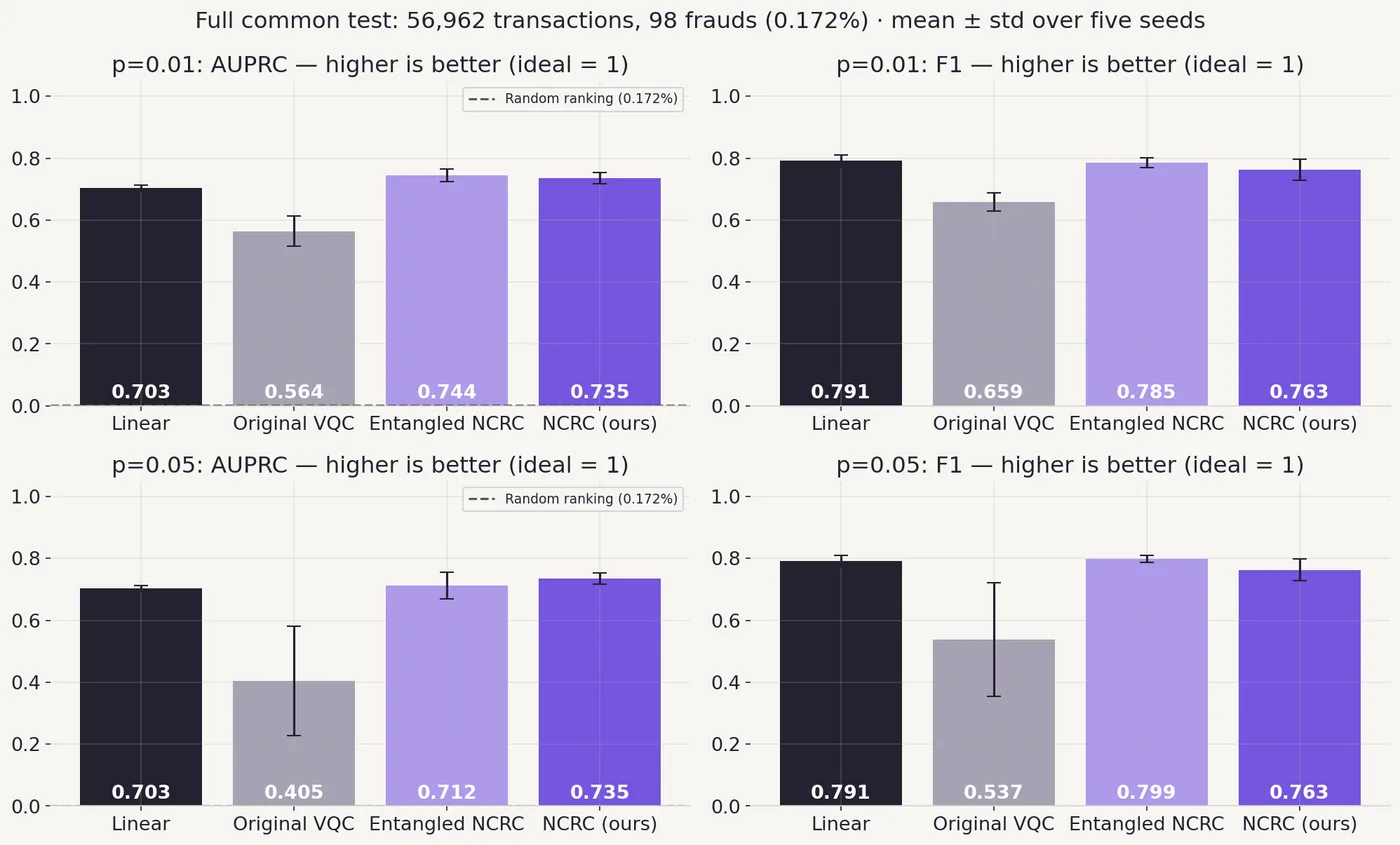
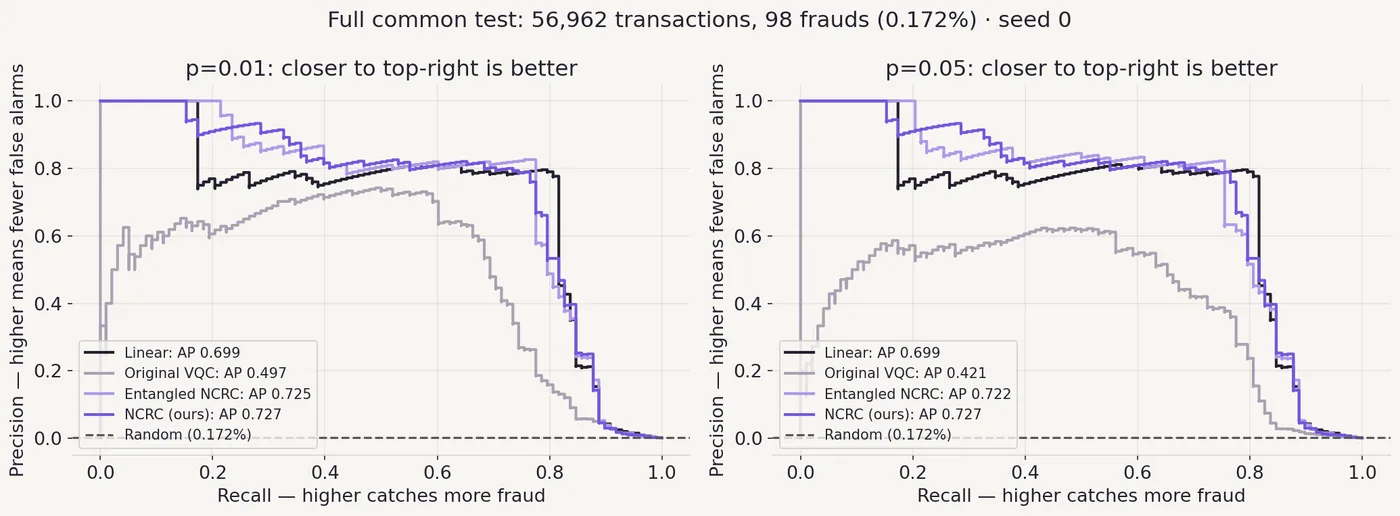
Results · full test set, 56,962 transactions, 98 frauds
- 0.735
- AUPRC for NCRC at p = 0.05 noise
- 0.405
- Original VQC at the same noise
- 1.000
- Spearman ρ: ranking preserved
- −88%
- Hardware executions, frugal schedule
The problem
Quantum classifiers face noisy hardware and limited measurement budgets. Fraud detection adds an imbalanced dataset, making both prediction quality and computational cost important.
What we built
BreaQ develops the Noise-Covariant Re-uploading Classifier (NCRC): four independent quantum wires that preserve transaction rankings under the specified depolarizing-noise model. The pipeline uses PennyLane and PyTorch, compares against classical baselines on the ULB credit-card dataset, and tracks circuit executions and measurement shots.
Under the hood
Symmetry-aware circuit design and packed parameter-shift gradients make the classifier resilient to the tested noise model while reducing execution costs. The project also checks finite-shot readout and other noise channels, without claiming quantum advantage over classical machine learning.